
 Book Free Consultation

Agentforce vs Traditional Salesforce Automation
Discover how Agentforce differs from Flow, Apex, and traditional chatbots, and how AI-powered agents are transforming Salesforce automation for CRM teams today.
By Madhan Kumar Chandrasekaran
Assistant Software Developer
Agentforce vs Traditional Salesforce Automation
Introduction
Salesforce automation has evolved in stages Workflow Rules, Process Builder, Flow, Apex but every one of these tools works the same way someone writes a rule in advance, and the platform executes it exactly, forever. That's been true for over a decade, and for most of what Salesforce orgs do, it still holds.
Agentforce is Salesforce's attempt at something different. It's framed as the third wave of AI on the platform, after predictive AI and copilots, and it's built to anticipate, plan, and act with minimal hand-holding rather than waiting to be asked. This blog breaks down how Agentforce actually differs from Flow, Apex, and older chatbots, and where it fits into an org with years of automation already in place.
What Is Agentforce?
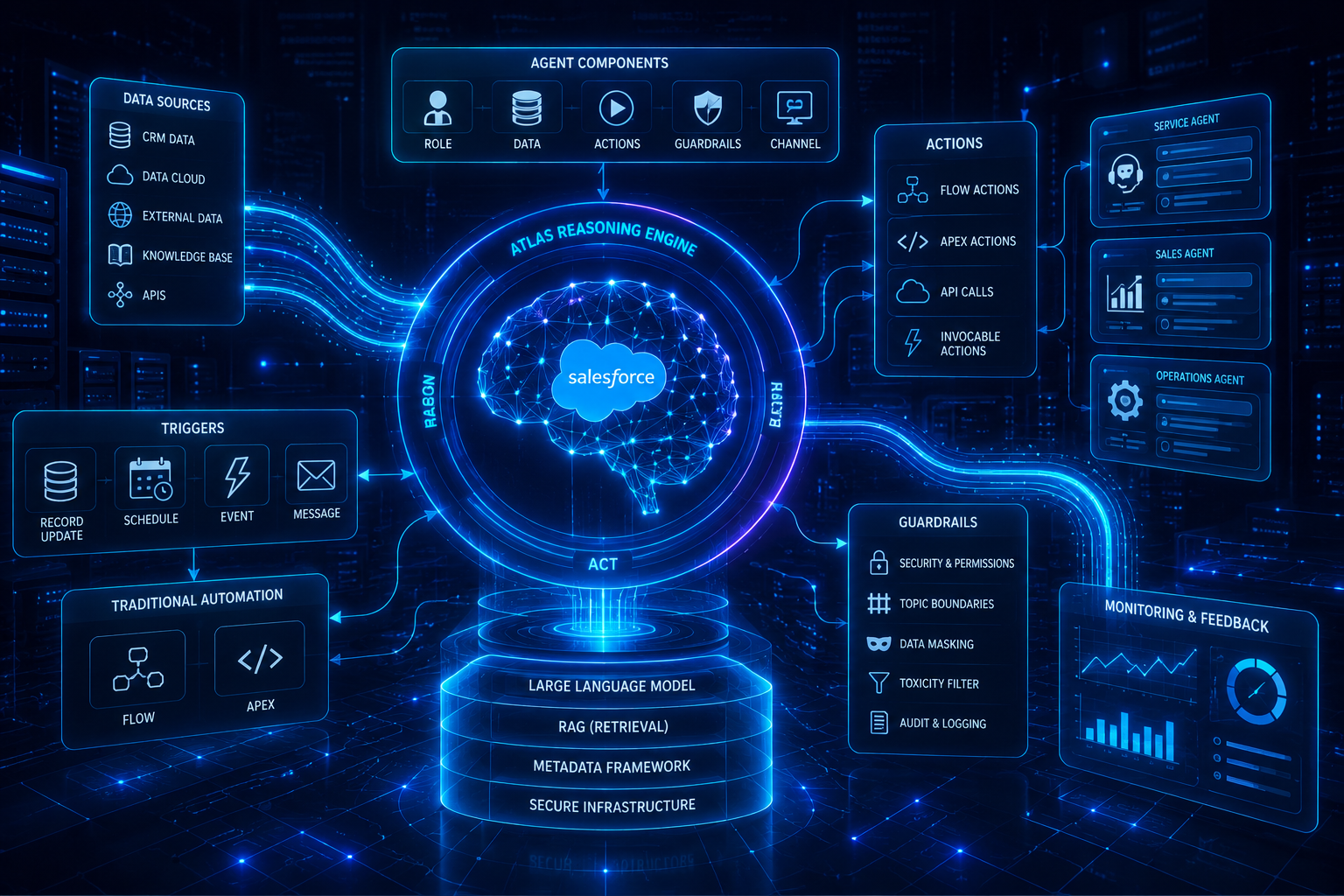
At the center of Agentforce is something Salesforce calls the Atlas Reasoning Engine, described internally as the "brain" of the platform. It was incubated inside Salesforce AI Research and is built to bring what Salesforce calls "System 2" reasoning to enterprise workflows slower, more deliberate reasoning, rather than a fast pattern-match response.
Every agent built on Atlas is defined by five components, according to Salesforce's own documentation:
Role what the agent's job or purpose actually is
Data what knowledge and information it's allowed to access
Actions the specific capabilities and tasks it can perform
Guardrails the boundaries and restrictions on what it's allowed to do
Channel where and how it operates
That last point is easy to miss. A user typing a message is only one way to trigger an agent. Salesforce's own materials describe agents being triggered by CRM data operations too a case status changing, an email arriving, a meeting starting in five minutes. That proactive capability is part of what separates this from a chatbot that just sits there waiting for someone to type something first.
Salesforce also ships ready-made agent roles out of the box rather than requiring every org to build from scratch. A Service Agent, for instance, is built to replace traditional chatbots and handle a wide range of service issues without needing every scenario preprogrammed. A Sales Development Representative agent engages prospects around the clock, answers questions, manages objections, and books meetings based on CRM and external data. Both are meant to escalate to a human the moment something falls outside their scope. You can see the full lineup on Salesforce's Agentforce product page.
Agentforce vs Flow and Apex: Key Differences
1. Trigger Model: Event-Driven vs Intent- and Signal-Driven
Flow and Apex wait for a specific, predefined event a record saves, a field changes, a schedule fires and then run the exact path someone built for that trigger. Agentforce can be triggered the same way, by a CRM data change, but it can also respond to a person's actual intent, expressed however they happened to phrase it. Either way, once triggered, it isn't just matching an event to a fixed path it's reasoning about what should happen next.
It's worth being honest about the trade-off. Predictable is a feature, not a bug, for approval chains, financial calculations, anything you'd need to explain line-by-line to an auditor. Nobody's suggesting you hand those over to agent judgment.
2. Decision Logic: Deterministic Rules vs a Reasoning Loop
Flow and Apex are deterministic. Same input, same output, every time. Agentforce runs differently: Atlas classifies the request into a Topic, retrieves relevant knowledge through retrieval-augmented generation against Data Cloud and other sources, and works through the request sometimes asking a clarifying question, sometimes refining its own plan before acting. Salesforce's engineering team has described this as a real step up in accuracy compared to the Chain-of-Thought approach used in the original Agentforce Assistant.
3. Execution Model: Standalone Logic vs Orchestration Through Topics and Actions
This is the part that's easy to gloss over: Agentforce mostly isn't running new logic at all. Each Topic scopes what an agent is allowed to consider and supplies the instructions, constraints, and available Actions for that context and those Actions are frequently just the Flows and Apex methods your org already has, exposed to the agent through Agent Builder. Salesforce's own release notes back this up: recent releases have shipped new standard Topics and Actions specifically so teams can use out-of-the-box capability instead of building everything custom, while still fully supporting custom Apex and Flow actions underneath.
That's good news if your team has already put real effort into the automation architecture. None of it gets thrown away it becomes the toolkit the agent reaches into.
4. Conversational Interface: Scripted Bots vs Grounded, Verified Reasoning
Older Salesforce bots ran on scripted, decision-tree logic that broke the moment someone phrased something slightly off-script. Agentforce is grounded in live data through RAG, and Salesforce has been actively hardening the security model around this. Recent release notes describe new verification actions that require a confirmed Contact ID before an agent can perform sensitive tasks, replacing older actions that worked off an unverified Contact Record. That's a meaningful detail it shows Salesforce treating agent actions with the same identity-verification discipline as any other sensitive operation, not as a chat feature bolted on as an afterthought.
5. Availability and Reach: Business Hours vs 24/7 Across Channels
Traditional automation and human-staffed processes both run on business hours in practice, even when the underlying Flow could technically fire anytime. Agentforce is built for continuous operation Salesforce positions it as delivering support around the clock, extended across the web, phone, and app channels a customer might already be using, rather than confined to a single case queue.
Real-World Signals This Isn't Just a Pitch Deck
It's fair to be skeptical of vendor claims about a brand-new product category, so it's worth looking at what's actually been reported rather than taking the framing at face value. Salesforce has published its own account of putting Agentforce to work on salesforce.com itself: an agent that pops up across the site handled more than 100,000 conversations and influenced roughly 30,000 sales leads within a few months, with an 18% increase in downstream conversions among visitors who engaged with it. The number of visitors handed off to sales development reps dropped, since the agent absorbed a lot of the basic questions but the people who did get transferred were, on average, more qualified.
Separately, a third-party report from Valoir cited by Salesforce found that Agentforce can cut time-to-market by roughly 16 times compared to building agent capability from scratch, with meaningfully higher accuracy. Numbers like that deserve the usual skepticism you'd apply to any vendor-cited study but they're at least a real, published data point rather than a hypothetical.
There's also a quieter signal worth noting: Salesforce added a dedicated Agentforce AI section to the Certified Platform Administrator exam blueprint at the end of 2025, carrying real weight in the exam. When a certification body restructures its core admin exam around a feature, that's usually a sign the feature has moved from "interesting new thing" to "something admins are expected to actually know."
How Agentforce Fits Into Your Salesforce Architecture
Put simply: your Flows and Apex classes are the toolbox, and the agent is what decides which tool to pick up.
A request comes in through a channel, or through a CRM signal. Atlas classifies it into a Topic, which scopes what the agent is allowed to do in that context and supplies its instructions and guardrails. It retrieves whatever knowledge it needs, decides which Action fits an Apex method, a Flow, a prompt template, or a standard action Salesforce shipped out of the box and calls it. That action runs exactly the way it always has. The agent then checks the result and either responds, takes a follow-up step, or hands off to a person if the request falls outside its defined scope.
Here's a simplified example of what an exposed Apex action looks like on the backend, so the agent has something concrete to call:
apex:
public class CheckOrderEligibility {
    public class Request {
        @InvocableVariable(label='Order Id')
        public String orderId;
    }
    public class Response {
        @InvocableVariable(label='Is Eligible')
        public Boolean isEligible;
    }
    @InvocableMethod(label='Check Order Eligibility'
        description='Determines if an order qualifies for expedited processing')
    public static List<Response> check(List<Request> requests) {
        // business logic here
        return new List<Response>();
    }
}
Nothing about your governance disappears in that chain. Permission sets, sharing rules, and validation rules still apply to whatever the underlying action actually does. What's new is the layer above it making sure Topics are scoped tightly, guardrails are meaningful, and the agent is consistently reaching for the right Action.
Best Practices for Rolling Out Agentforce
Start with Topics that are narrower than feels necessary. A tightly scoped agent is easier to trust and easier to debug when something goes sideways.
Take advantage of standard Topics and Actions before building custom ones. Salesforce ships new standard capability with nearly every release.
Spend real time on action labels and descriptions. Atlas selects actions based almost entirely on how clearly they're described.
Leave deterministic, high-stakes logic on Flow and Apex. There's no reason to route an approval chain through agent judgment.
Use Agent Builder's trace and console logging during rollout to catch misconfigured Topics early.
Treat the first rollout as a cross-functional pilot, not a single-admin project misalignment across stakeholders is one of the more common reasons AI pilots stall out.
Frequently Asked Questions
Does Agentforce replace Flow and Apex? No. Agentforce orchestrates existing Flows, Apex actions, and prompt templates rather than replacing them. Most of what an agent "does" is calling automation your team has already built.
Is Agentforce only for customer service? No. Salesforce ships out-of-the-box agent roles across service, sales, marketing, and commerce, and supports fully custom agents for other business functions.
How is this different from the old Einstein Bots? Einstein Bots ran on scripted decision trees. Agentforce is grounded in live CRM and Data Cloud data through retrieval-augmented generation, and reasons through a request rather than matching it against a fixed script.
Does this affect Salesforce certifications? Yes, Salesforce added a dedicated Agentforce AI section to the Certified Platform Administrator exam blueprint, effective from admin exams administered after December 15, 2025.
Conclusion
Traditional Salesforce automation Flow, Apex, Workflow Rules before them has always run on the same principle: a human writes the rule in advance, and the platform executes it exactly, every time. That model isn't going away, and it shouldn't. It's still the right choice for approval chains, financial logic, and anything that needs to be predictable enough to explain to an auditor.
That's really the lesson underneath all of this: don't replace what works, extend it with judgment where rules run out. Automation and intelligence solve different problems. Automation handles the predictable; intelligence handles the ambiguous. The teams getting real value from Agentforce aren't the ones tearing out their Flow and Apex investment to chase the newest thing they're the ones who know which of the two a given situation actually calls for, and who build their architecture so both can coexist. That judgment call, more than any feature checklist, is what separates a well-run Agentforce rollout from a stalled one."Automate what's certain. Reason where it isn't."
