
 Book Free Consultation

Mastering APIs And API-Led Connectivity In MuleSoft
Explore APIs from the basics and how the API-led connectivity works to provide scalable, secure, and digital ecosystems across industries in MuleSoft.
By Nishanth Sargunam
Senior Salesforce Developer
Mastering APIs And API-Led Connectivity In MuleSoft
Let's dive into the work that I made for collecting the valuable points to learn about the APIs and the API-Led connectivity and which is harder to gather the point to explain a bit clearly about the core concepts with real world use cases which is essential to learn about the architecture. The place where you can learn and take the knowledge on the topic of APIs and API-Led Connectivity.
In today's modern world, All the companies and every business interaction will operate based on the data. But here’s the catch: most organizations don’t have a single system of record. Instead, they handle with legacy ERPs, CRMs, cloud apps, mobile platforms, and IoT devices.
Traditionally, integration was addressed through point-to-point wiring or monolithic ESBs which is nothing, but all the logics, routing, transformation and orchestration will be packed into one big runtime. Although these solved the problem initially, they became quick bottlenecks—static, difficult to scale, and costly to maintain. Enter MuleSoft's API-led connectivity: a new way that doesn't only integrate systems but establishes a self-service application network where APIs are reusable, discoverable, and governed.
API (Application Programming Interface)
An API is a set of rules that allow different types of applications to communicate with each other. It connects two systems so they can exchange information — for example, the client sends data to the server, and the server returns data to the client. Before APIs were created, sharing data with other systems was hard and took a lot of time. Most organizations share the data on file-based methods to share data with external systems or sometimes connected directly to outside databases, which was risky and insecure. These challenges led to the introduction of APIs, which make communication between systems easier, allow reusability, and help save time.
Type of APIs
There are many different types of APIs, each designed for specific purposes and unique use cases. The common types of APIs are as follows.
Open APIs / Public API: Available to anyone, these APIs allow external users to access data and services via HTTP. They are developer-friendly and widely used for easy integration across platforms.
Internal API: Used only within an organization, these APIs enable internal systems and teams to share data and services securely, promoting collaboration and reusability.
Composite API: Combine multiple API calls into a single request, simplifying complex interactions, improving performance, and providing a better user experience.
Partner API: Accessible only to authorized partners, these APIs allow controlled integration with external systems, offering secure access to specific services and functionalities.
Web Services
A web service helps to connect the application needs to communicate and share the data with each other. A web service is a software system that allows different applications to communicate over the internet using standard protocols like HTTP, XML, OR JSON. We use two types of web services to send requests and receive responses from the server. They are,
SOAP: Simple Object Access Protocol is a protocol-based web service that uses XML to send and receive data. It follows strict standards, making it highly secure and reliable. SOAP is often used in enterprise-level applications where transactions and data integrity are critical. SOAP supports advanced features like transaction management, ACID (Atomicity Consistency Isolation Durability), compliance, and error handling.
REST: Representational State Transfer is an architectural style that uses HTTP methods such as GET, POST, PUT, and DELETE to exchange data. It usually communicates in JSON, making it lightweight, fast, and easy to use. REST APIs are widely used for web, mobile, and social media applications due to simplicity and performance.
Difference between HTTP and HTTPS
HTTP (HyperText Transfer Protocol) is the basic protocol used for communication on the web. It enables the transfer of data such as text, images, and videos between client and server. It doesn’t encrypt the data, making it unsafe for sharing sensitive information like passwords or payment.
HTTPS (HyperText Transfer Protocol Secure) is a secure version of HTTP. It uses SSL (Secure Sockets Layer) or TLS (Transport Layer Security) encryption to keep data private and prevent hackers from reading or changing it. It also verifies that users are connected to the website.
HTTP is suitable for normal browsing, but HTTPS is suitable for securely transferring data such as banking or shopping websites.
Difference between API and Web Service
Feature | API | Web Service |
Network Dependency | Can work with or without network connection | Always requires a network |
Protocol Used | Can use any protocol such as HTTP, HTTPS, TCP or even local calls | Used standard web protocols like HTTP, HTTPs, SOPA or XML |
Data format | Can exchange data in formats like JSON, XML or plain text | Topically uses XML (in SOAP) or JSON(REST) |
Usage | Used for software-to-software communication, both locally and online | Used specifically for system-to-system communication over the web |
Type | A broader concept — all web services are APIs, but not all APIs are web services. | A specialized type of API designed for web-based communication. |
API-Led Connectivity
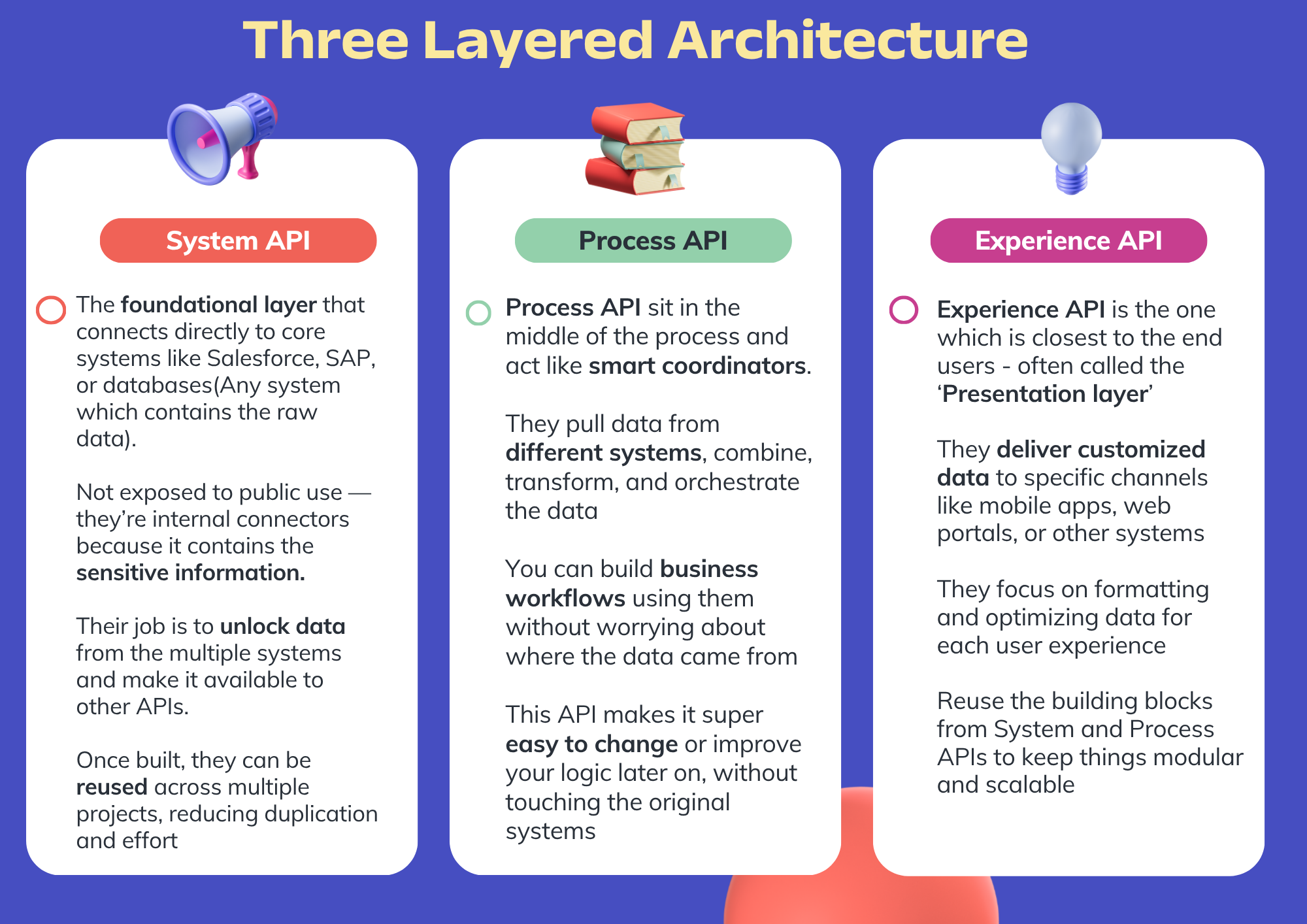
API-led connectivity is the architectural approach which is introduced by MuleSoft for integration that organizes APIs into three distinct layers, creating reusable and purposeful building blocks: System APIs, Process APIs, and Experience APIs. This methodology connects data to applications with a connected network of APIs, making it quicker to manage and better reusing the recipes rather than having direct, point-to-point connections. This approach results in a faster IT delivery and better business agility.
Application Network
An application network, which is a unique and adaptable system for using APIs to integrate applications, data, and devices, is a flexible, scalable system that integrates various applications, data sources, and devices through APIs. Instead of connecting systems together, each system exposes its functionality via APIs that can be reused, combined, and governed centrally.
Think of it as a digital ecosystem, where every app is simply a plug-and-play component. APIs work like modular, reusable building blocks which allow teams to be able to:
- Share data in a secure way.
- More quickly build new features for end user consumption.
- Avoid creating the same thing twice which we can call it as redundancy.
- Maintain consistency across environments.
Evolution of API-led connectivity
The journey to API-led connectivity began with the earliest form of integrations: point-to-point connections. In this model, each system was directly connected to another, which worked fine when there were only a few systems involved but quickly turned into a tangled "spaghetti architecture" of connections as businesses added more applications.
To address the issue caused by direct point-to-point connections, companies in the 2000s started using something called an Enterprise Service Bus. Then, as businesses began to embrace the cloud, SaaS, and mobile technologies in the 2010s, APIs emerged as the go-to mechanism for exposing and consuming data. RESTful APIs, in particular, made integrations lighter and more developer-friendly; however, when developed in silos, they led to duplication, inconsistency, and governance issues.
This gap in previous integration approaches gave rise to API-led connectivity—a structured approach discovered by MuleSoft that organizes all the APIs into three distinct layers: System APIs unlock data from core systems, Process APIs orchestrate and transform that data, while Experience APIs deliver data in a channel-specific way. Unlike the old days of ESBs or scattered APIs, this layered model encourages reusability, speed, agility, and governance, and allows organizations to build application networks where APIs act as reusable building blocks.
Today, API-led connectivity keeps on growing with event-driven architectures, universal API management across hybrid and multi-cloud environments, and AI-driven integration, making it the cornerstone of the modern digital enterprise.
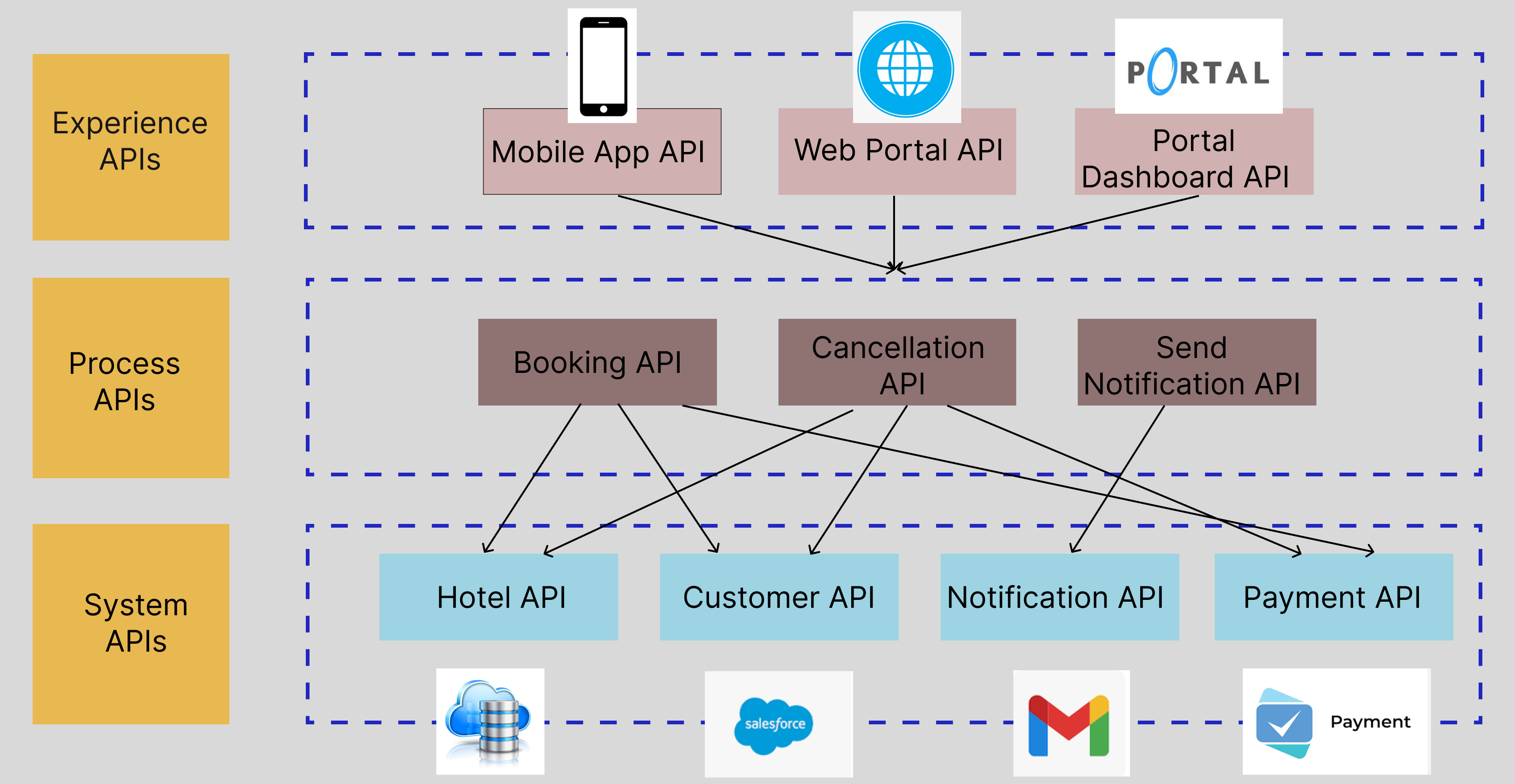
API-led connectivity accomplishes this by,
- Breaking integrations into modular APIs that can be reused throughout projects
- Providing governance and security through MuleSoft's API Manager
- Enabling faster delivery of new digital experiences through exposed Salesforce data in a controlled, consistent way.
Conclusion
We are at the end of the chapter that describes the concept of API and API-Led Connectivity. I hope all just learnt something from the content I have provided about the trend of the technology and the basement to learn. Whether you're building a simple integration or architecting a composable enterprise, the above stated will be helpful to build the strong knowledge. Stay tuned—there’s more to come.
