
 Book Free Consultation

Leveraging Financial Service Cloud for Financial Growth
Explore how businesses can harness Salesforce Financial Services Cloud (FSC) to achieve sustainable financial growth
By John Prabhu Gnanaraj
Asst. Software Developer
Leveraging Financial Service Cloud For Financial Growth
Introduction
Salesforce Financial Services Cloud (FSC) is a special version of Salesforce specifically designed for financial service-providing industries like banking, wealth management, insurance, and lending. This product helps financial institutions to build a stronger relationship with their clients and to deliver a personalized experience through automations to operate efficiently. Some of the main uses of implementing the FSC in financial institutions include Client Relationship Management, Customer Engagement, Loan and Mortgage management. Salesforce Financial Service Cloud is engineered to eliminate the friction of sales and service team members in the process of nurturing the client relationships. The FSC facilitates better communication between various departments by using a shared platform where everyone can access the same client data. Additionally, FSC ensures strong data security and compliance with industry regulations such as GDPR which helps in maintaining customer trust and to meet legal requirements.
Financial Services Cloud Architecture
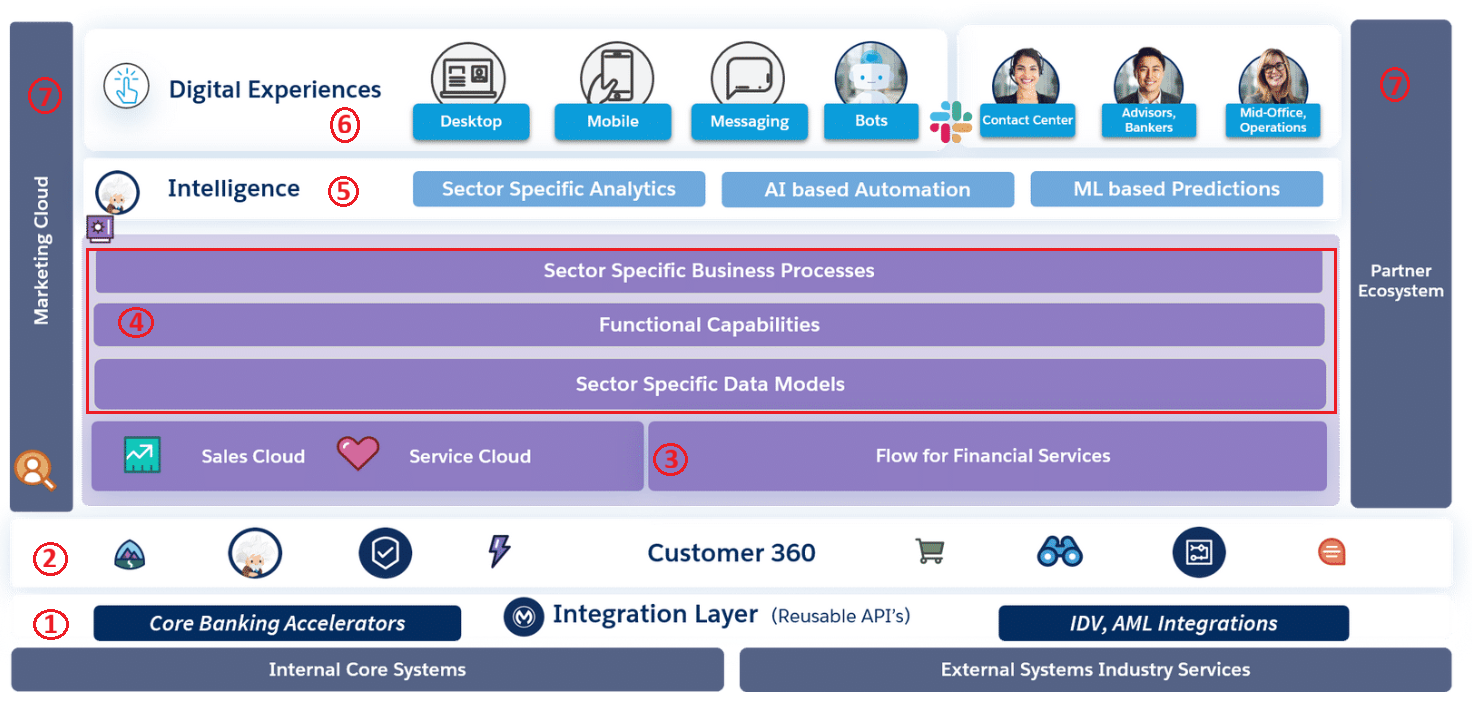
The financial services cloud comprises a 7-layered architecture as follows:
Core Function Layer (1)
This layer of FSC serves as a base and it helps in integrating with other external systems like core banking, centralized applications, etc.,
Core Banking Accelerators - Links with Internal banking systems like account management, loans, etc.
IDV, AML integrations - connects to external services for identity verification and anti-money laundering.
Customer 360 Layer (2)
This layer serves as the "Heart of Financial Services Cloud"- it gives a 360-degree view of each customer by combining all their data from various financial systems.
It provides access to sales, service, and marketing teams to view the updated customer's info to get proper insights.
Thus the Customer 360 layer helps in improving personalization and service to the customers anytime.
Core Cloud Layer (3)
Sales Cloud - manages leads, opportunities, and helps in improving client relationships.
Service Cloud - handles customer service cases and provides client support.
FSC automations - This layer consists of the automations that are involved (like loan approval, customer onboarding, etc.)
Sector-Specific Layer (4)
This layer includes three important sub-layers Sector-Specific Data models, Functional Capabilities, Sector Specific Business Processes
Sector-specific data models - consist of the pre-built data models that are required to run a financial system like Insurance model, Client data model, etc.,
Functional capabilities - tools for managing clients and cases - then help in processes like client onboarding, compliance management, and relationship management.
Sector-Specific business processes - contains pre-built workflows for banking, insurance and wealth management, etc.,
Intelligence Layer (5)
Sector-specific analysis gives tailored insights into businesses by using the reports and dashboards.
Automates many processes and improves workflow with the usage of Einstein AI and improves efficiency.
ML(Machine Learning)-based predictions that might help customers to make predictions for future investments.
Digital Experiences Layer (6)
This is the layer in which the customer and employees interact with the Salesforce user interface.
The DE layer is explored by the usage of desktops, mobiles, messaging, bots, contact centers, and middle office operations.
This layer provides the different ways in which the user can experience the FSC system.
Some of the users included in this layer are Contact center agents, Advisors and bankers, Mid-office and Operations teams, etc.,
Partner Ecosystem and Marketing (7)
Salesforce works with many external vendors, fintech partners, and app partners to extend FSC capabilities.
Provides expertise in compliance, data security, and local financial regulations.
Integrates with Marketing cloud to deliver personalized marketing campaigns indeed to nurture leads.
Principles of Financial Services Cloud
Relationship and Interaction: The relationship mapping concept is used to visualize complex relationships between individuals, households, and businesses using the Actionable Relationship Center (ARC) feature. Using ARC, we can be able to track reciprocal roles, such as the relationship between a client and their lawyer or between two business entities. It provides personalized engagement by delivering tailored advice and proactively engaging with clients, which significantly improves user experience and reduces response times.
Process Efficiency: The FSC mainly operates in a centralized platform that is designed to improve collaboration across departments and to streamline processes. These kinds of processes revolutionize operational workflow for many financial institutions by significantly enhancing productivity and efficiency. We can use automated workflows and approval processes for tasks like customer identity verification and compliance checks to save time and reduce errors.
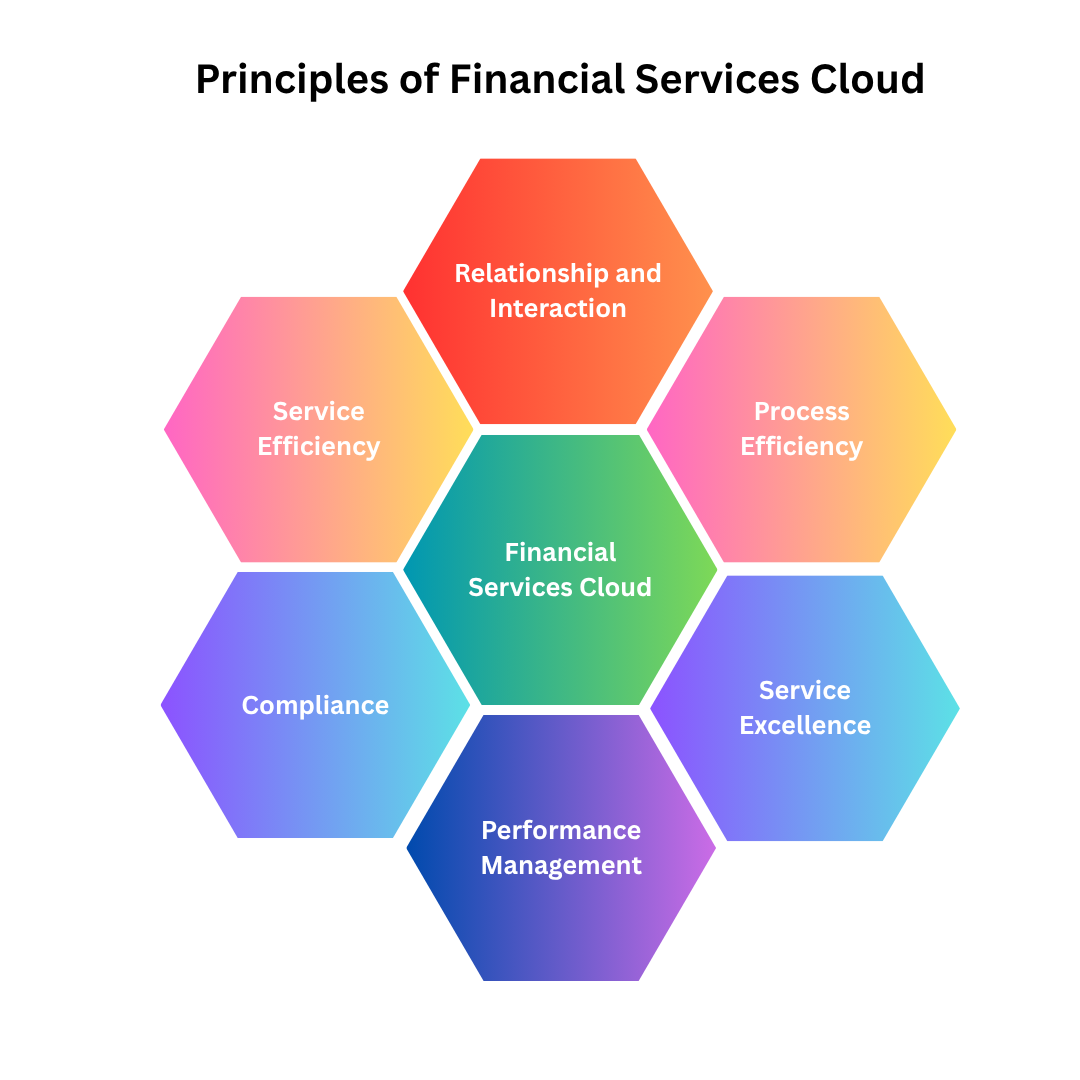
Service Excellence: By consolidating all the customer data, FSC enables financial professionals to deliver timely and personalized services, which builds stronger customer relationships. There are other options like self-service portals that are built using Experience Cloud. Both clients and brokers can manage their own accounts, statements and get answers to their queries.
Compliance: The FSC automates compliance monitoring, reporting, and audit trails to simply adhere to the regulations like KYC (Know Your Customer) and AML (Anti-Money Laundering). By integrating compliance processes into the CRM, FSC reduces the risk of regulatory breaches and minimizes the administrative burden. The FSC mainly configures granular, role-based access that controls and protects sensitive client information.
Performance Management: FSC provides robust analytics and reporting capabilities that enable financial institutions to make data-driven decisions and track key performance indicators (KPIs). It mainly helps the Sales and Marketing team to manage leads, track opportunities, and monitor the results from the marketing campaigns. To enhance the risk management by analyzing the data, and from the insights, we can identify growth opportunities.
Benefits of Financial Services Cloud:
360 Degree Customer view: Salesforce FSC provides a unified view of each client by consolidating their data from various sources. This holistic perspective allows financial advisors and service teams to understand customer needs.
Improved Client Relationship Management: With the built-in tools in FSC we can track customer interactions these allows teams to nurture client through the entire financial journey.
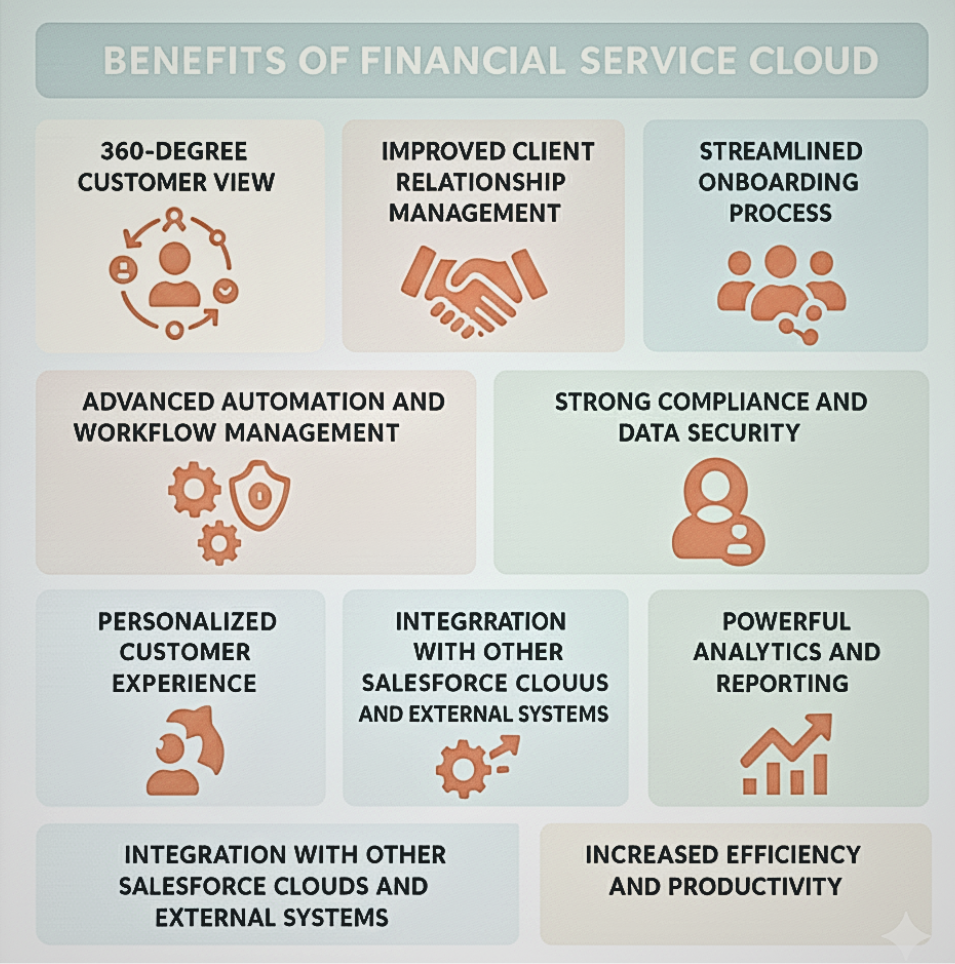
Streamlined Onboarding Process: FSC simplifies and accelerates the onboarding process by automating repetitive tasks such as document collection, Identity verification and compliance checks.
Advanced automation and workflow management: This platform includes various powerful automation tools to streamline operations like loan approvals, claims processing and portfolio management.
Strong compliance and Data security: FSC is designed with robust compliance and data security measures that meet industry standards such as GDPR, KYC and AML.
Integration with other external systems: FSC integrates with other salesforce solutions such as Sales cloud, Service cloud and Marketing cloud as well as external financial systems. It improves overall operational efficiency.
Powerful Analytics and Reporting: FSC's Einstein analytics and customizable dashboards improves businesses with real-time data insights.
Conclusion
Salesforce Financial Service Cloud (FSC) is revolutionizing the way all the financial institutions operate by providing a unified platform. FSC bridges the gap between sales, service and marketing teams - enhancing the operational efficiency. FSC ensures that every interaction with client is meaningful and value-driven. Financial Service Cloud equips organizations to adapt to market changes and consistently deliver service excellence.
"Empower your financial future with Salesforce Financial Services Cloud - where relationships grow stronger, insights get smarter and success becomes seamless".
