
 Book Free Consultation

Salesforce Headless 360: Explained
Explore how Salesforce Headless 360 lets businesses use Salesforce anywhere through APIs and AI agents - without needing to log in to the platform.
By John Prabhu Gnanaraj
Asst. Software Developer
Salesforce Headless 360: The Future of Using Salesforce Without Logging In
How about accessing Salesforce without even having to log into the platform? This is precisely what the concept of Salesforce Headless 360 is all about. The platform can be converted into an API-first and AI-capable ecosystem to access and use data, automate workflows, and deliver customer experiences in applications, chats, and digital mediums without having to sign in or navigate the interface manually. With the advent of AI agents into the world of business, Salesforce Headless 360 is revolutionizing the way organizations interact with enterprise software.
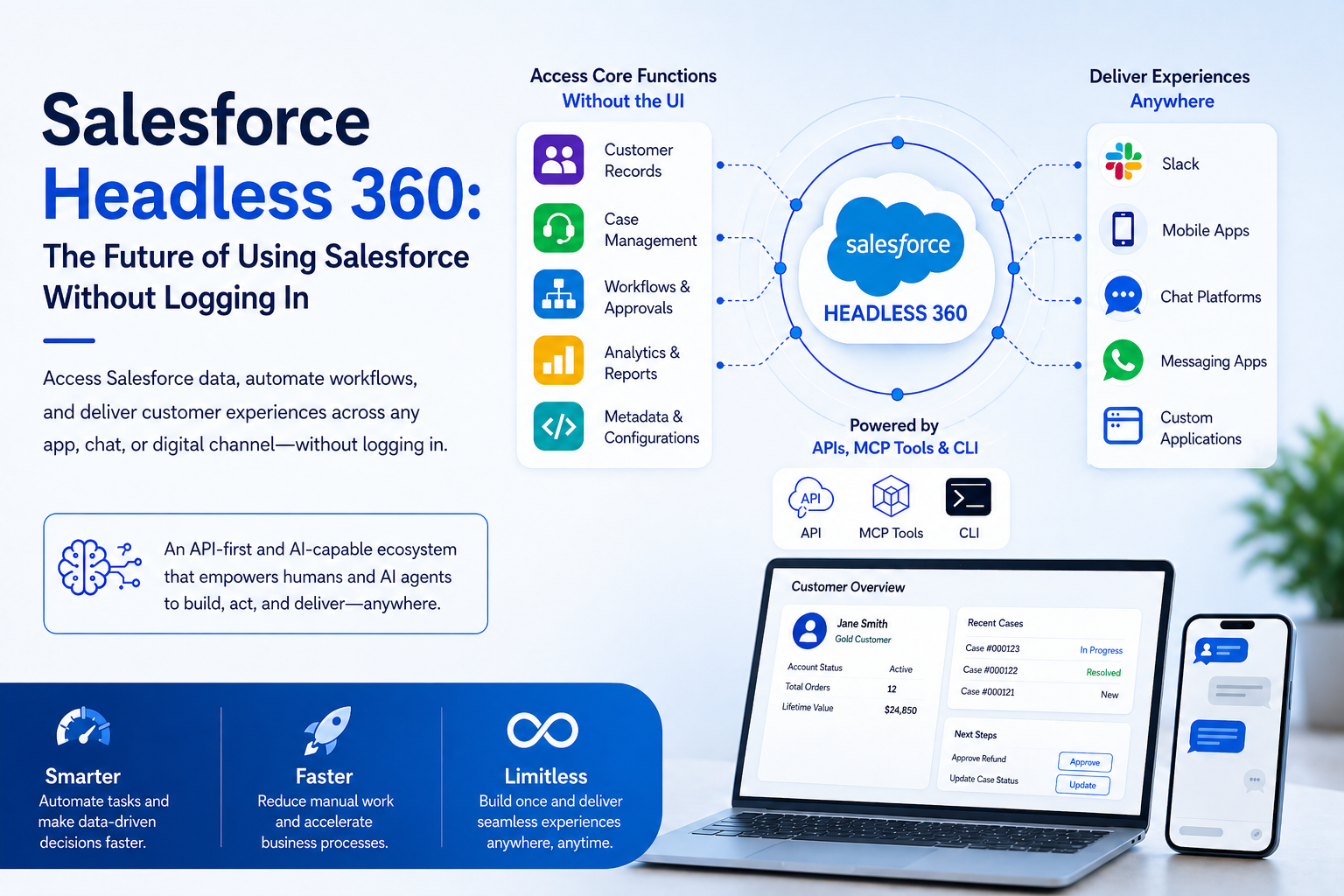
Salesforce Headless 360 is the latest programmable platform design of Salesforce that makes available the core Customer 360 functionalities through APIs, MCP tools, and CLI commands. In doing so, users, as well as AI agents, can build, act, and provide experiences using the platform without having to go through a particular user interface of Salesforce.
What does "Headless" mean in salesforce?
Traditionally, if a person wanted to use Salesforce, they had to access the software, use dashboards, open records, work on cases, or even perform workflows through Salesforce cloud application. The interface was the main gateway for getting the work done. But with Salesforce Headless 360, now that model has changed completely. Rather than forcing the users to interact within a particular UI, Salesforce features can be utilized via APIs, MCPs, and CLIs. This means that businesses are free to work with their Salesforce resources in any other app or conversation interface of their choice.
In simple terms, the term 'head' represents the front-end, whereas the term 'body' indicates the backend. Headless is the concept that does not depend on the front end and allows backend functionalities to be used whenever necessary.
How Salesforce Headless 360 Works?
Salesforce Headless 360 transforms valuable parts of the Salesforce ecosystem into programmable services. Humans and AI agents can access these services from any environment. At the center of this model is API-first access. Core functions like customer records, case management, workflows, approvals, metadata, and analytics can be accessed directly through APIs. An AI agent or external application can trigger a support case update instantly, rather than requiring manual input through a console.
Another key part is MCP tools and coding skills. Salesforce has introduced more than 60 MCP tools and over 30 preconfigured coding skills. These give developers access to the platform. The tools allow coding assistants like Cursor, Claude Code, and Codex to interact directly with Salesforce environments. Headless 360 also features a new Experience Layer. This separates business actions from their visual presentation. For example, an agent can start a refund workflow or approval process while the interface displays as an interactive card in Slack, mobile apps, messaging platforms, or collaboration tools.
An important aspect is trust and governance. Since AI agents behave dynamically and probabilistically, businesses need control systems. Salesforce provides testing tools, observability, A/B testing, scoring models, and governance frameworks. This ensures organizations can monitor agent behavior before and after deployment.
Why Salesforce is Moving Toward Headless Architecture
Salesforce is adopting headless architecture to keep up with the rising need for speed, flexibility, and scalability in modern business operations. Traditional CRM models required users to log into a platform, navigate screens, and manually complete tasks like updating records, approving requests, or triggering workflows. While this approach worked well in the past, this can now slow down operations in a digital-first world where businesses require instant responses and seamless experiences.
Headless architecture removes the reliance on a single user interface. Instead of depending on employees to click through screens, systems, applications, and AI agents can communicate directly with Salesforce through APIs, automation tools, and services. This enables actions to take place in real time, whether that means updating customer information, routing a support request, approving a workflow, or generating insights.
Driving factors behind this transition include,
Faster execution through automation reduces delays from manual steps.
It also cuts down the dependency on repetitive user actions like data entry or status updates.
Seamless integration across platforms, which includes internal tools, customer channels, and third-party systems.
Organizations can scale better as they grow, expand channels, and manage larger workloads.
Leads to improved agility in launching new experiences without having to redesign backend systems.
Key Features of Salesforce Headless 360
API-First access: Organizations can use Salesforce data and workflows through APIs rather than relying on manual platform navigation.
MCP Tools for AI Agents: With dozens of new tools and coding skills, AI agents can securely access business logic, metadata, workflows, and records to automate work.
Experience Layer: Businesses can build once and deploy experiences across multiple channels such as Slack, mobile apps, chat tools, and messaging platforms.
Governance and Monitoring: Testing Center, session tracing, scoring evaluations, and A/B testing help enterprises safely deploy AI agents at scale.
Real-Time Business Context: Through Data 360, agents gain access to trusted customer data, relationships, service history, renewal dates, and operational context.
Challenges to Consider
Implementation Complexity: Moving to a headless architecture requires planning, integration design, and technical expertise.
Integration Strategy: Businesses must ensure external tools, custom apps, and workflows are securely connected.
Skill Gaps: Organizations may need developers skilled in APIs, modern frontend frameworks, automation, and AI systems.
Cost and Prioritization: Not every process needs to become headless immediately. Businesses should identify the highest-value use cases first.
Conclusion
Salesforce Headless 360 represents a significant shift in how enterprise platforms are used. Users are no longer limited to logging into dashboards and navigating screens; Salesforce can now operate as an intelligent business engine that is accessible anywhere. By opening up workflows, data, automation, and trust controls through APIs, tools, and AI agents, Salesforce is preparing for the future of work, where humans and digital agents work together smoothly across different surfaces. For businesses, this means faster operations, improved customer experiences, and more flexibility. Headless 360 is not just a product improvement. It marks the transformation of Salesforce from an application that people use into a platform that functions everywhere. No Screens. No Limits. Just Salesforce Everywhere.
