
 Book Free Consultation

Optimizing the Quote-to-Cash Process with Revenue Cloud
Discover how Salesforce Revenue Cloud streamlines the entire Quote-to-Cash process from product configuration and pricing to billing and revenue recognition.
By Suryaprakash Murugesan
Associate Salesforce Developer
Optimizing the Quote to Cash Process with Salesforce Revenue Cloud
What is Quote-to-Cash Process(QTC)?
The Quote to Cash (QTC) process is a critical end to end business processes that handles the entire sales lifecycle, from a customer’s initial interest on Product to receiving payment for the Product. It connects the gap between the Sales organization's efforts to close a deal and the Finance team's responsibility to recognize the resulting revenue. An optimized QTC process ensures that a business converts a sales opportunity into actual cash flow as quickly and accurately as possible.
The Stages of QTC
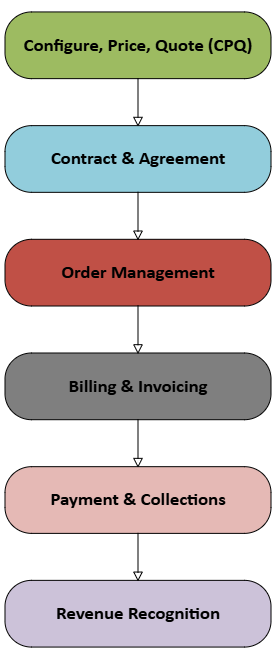
Challenges in the Traditional QTC Process and Importance of QTC for Revenue Growth
- The Quote to Cash (QTC) process is the core of revenue generation, directly impacting how quickly and accurately a business can move from customer interest to realized revenue. In today’s fast moving and highly competitive markets, organizations can no longer rely on slow, manual sales and billing processes. A well optimized QTC process accelerates the sales cycle, improves pricing accuracy, enhances customer experience, and ensures compliance with revenue recognition standards all of which are critical for sustainable revenue growth.
- However, many organizations still struggle with traditional QTC models that rely on disconnected systems and manual workflows. Separate tools for CRM, CPQ, contract management, billing, and revenue recognition create data separation, limiting visibility across the customer journey. Sales and finance teams often work in isolation, leading to miscommunication, duplicate data entry, and delayed decision making. This lack of real time insight slows growth and increases operational risk.
- Manual processes further compound these challenges. Spreadsheets, emails, and offline approvals introduce errors in pricing, discounting, contracts, and billing. Lengthy approval cycles for pricing, legal, and finance slow down quote generation and contract negotiation, extending sales cycles and delaying revenue recognition. Additionally, contract creation and order conversion become slow, causing delays between deal closure and fulfillment negatively impacting customer satisfaction.
- When QTC processes are inefficient, businesses face revenue leakage, inconsistent customer experiences, compliance risks, and unpredictable cash flow. These issues may potentially get worse as businesses expand. Optimizing the QTC process through automation and integration not only removes these problems but also enables faster deal closures, higher win rates, improved compliance, and predictable cash flow laying a strong foundation for long term revenue growth.
How Salesforce Revenue Cloud Optimizes Quote-to-Cash(QTC)?
Salesforce Revenue Cloud transforms the traditional Quote to Cash process into a unified, automated, and customer centric experience. By bringing together Configure Price Quote (CPQ), Billing and Revenue Management into a single platform, Revenue Cloud enables businesses to sell faster, reduce errors, and accelerate revenue recognition.
1. Unified Platform for End-to-End Revenue Management
Revenue Cloud connects sales, finance, and operations on a single platform. By eliminating data difficulties, it ensures that every stakeholder from sales reps to finance teams has access to real time data, creating a seamless and efficient flow from quote to cash.
2. Quote Generation
Salesforce Revenue Cloud includes Configure, Price, Quote (CPQ) capabilities that automate the most complex part of the sales cycle.
- Guided Selling: Sales reps are guided to select the right product combinations and bundles based on customer needs, ensuring they never quote an invalid configuration.
- Dynamic Pricing: It enforces all pricing rules, discounts, and approval thresholds automatically. This eliminates manual spreadsheet errors and ensures pricing is always accurate and profitable.
- Faster Approvals: Automated approval workflows based on discount percentage or deal size cut down approval time from days to minutes, significantly accelerating the sales cycle.
3. Order & Contract Management
Revenue Cloud centralizes contract and order management to ensure a seamless transition from quote to contract and order. It automates the creation of professional, audit ready contracts using pre approved templates. Complex orders are broken down into technical fulfillment steps and automatically routed to the systems like ERP or inventory for fulfillment, minimizing order fallout and speeding up delivery.
4. Billing and Invoicing
Once a deal is closed, With Salesforce Billing Revenue Cloud automates billing and invoicing based on whether it is a onetime charge, usage based billing, or a recurring subscription. This process eliminates manual handoffs between sales and finance, reducing errors and ensuring faster collections. Invoices are generated automatically based on the contract terms, ensuring accuracy and consistency. It also supports multi-currency and multi-language billing for global operations.
5. Asset Lifecycle Management
Salesforce Revenue Cloud simplifies asset management by automatically creating and tracking customer assets after a sale. It supports lifecycle actions like renewals, upgrades, and cancellations, helping teams manage subscriptions and entitlements efficiently. With tools like the Managed Asset Viewer and built in automation flows, businesses gain better visibility and control post sales operations.
6. Revenue Recognition
In Salesforce Revenue Cloud, revenue recognition is the automated process of recording and recognizing earned revenue according to accounting standards like ASC 606. It uses rules and treatments to define how and when revenue is earned and distributed over time, regardless of when a customer is invoiced. This automation helps reduce errors, ensure compliance, and provide better financial tracking compared to manual methods.
Use Case: Streamlining Quote to Cash for a Subscription Based SaaS Company
Consider a growing SaaS company that offers subscription based products with multiple pricing tiers, add-ons, usage based components, and frequent contract renewals. In a traditional QTC setup, the sales team relies on spreadsheets to configure pricing and discounts, while finance manages billing and revenue recognition in separate systems. This results in inconsistent quotes, long approval cycles, billing errors, delayed invoicing, and revenue leakage especially as deal complexity increases.
By implementing Salesforce Revenue Cloud, the company can unify its entire Quote to Cash process on a single platform. Sales reps use CPQ to generate accurate quotes with guided selling and automated discount approvals. Once the deal is closed, contracts and orders are created automatically and routed for fulfilment without manual intervention. Salesforce Billing handles recurring subscriptions, usage based charges, and invoicing, while automated revenue recognition ensures compliance with ASC 606. Asset lifecycle management enables seamless renewals, upgrades, and amendments. As a result, the company reduces sales cycle time, improves billing accuracy, accelerates cash flow, and gains real time visibility into revenue, enabling scalable growth and an improved customer experience.
Conclusion
Optimizing the Quote to Cash (QTC) process is necessary for businesses aiming to scale efficiently and deliver good customer experiences. Salesforce Revenue Cloud helps organizations to transform manual workflows into automated process for revenue generation. By integrating CPQ, Billing, and Asset Management on a single platform, Revenue Cloud accelerates sales cycles, improves pricing accuracy, enhances compliance, and ensures predictable cash flow. As markets evolve and customer expectations rise, businesses that uses a streamlined QTC process will be better positioned to grow revenue, reduce operational difficulties, and stay ahead of the competition.
